The Old Boot Planter Fallacy: More Than Just “Fun”
Why Mass Production Kills The Point
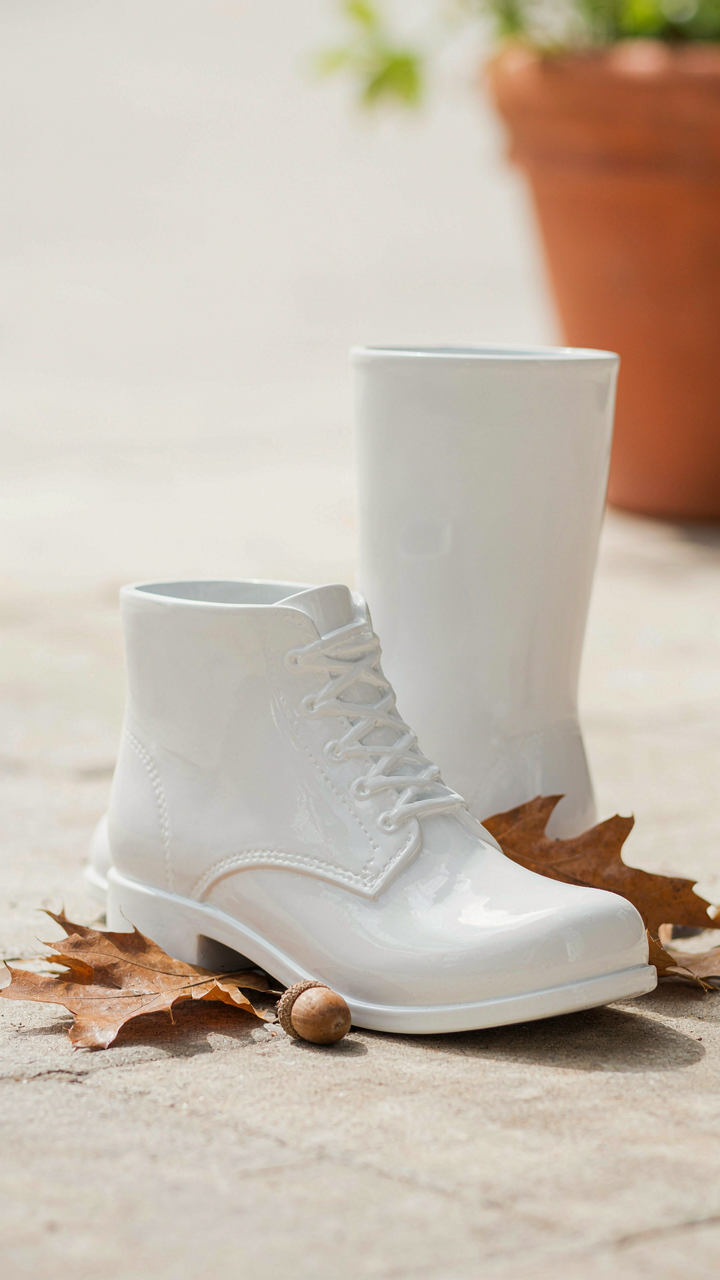
You want permission to feel like you’re doing something original without actually committing to the work. That’s the real draw of this trend. The mechanism is simple: mass-produced garden kits—plastic boot molds, kitschy ceramic pairs, pre-assembled planters shaped like footwear—strip away the singular quality that made old boot planters worth making in the first place. They’re designed for scale, not for your specific garden or aesthetic.
Genuine old boot planters emerged from utility and material limitation, not trend cycles. Gardeners repurposed actual worn work boots because they had them and needed drainage vessels. When you buy a mass-produced “vintage-style” boot planter, you’re buying the aesthetic of resourcefulness without the resourcefulness. The object betrays itself. Your garden reads as trend-conscious, not intentional.
The Work Behind Apparent Simplicity
Common advice says old boot planters are effortless—just find an old boot and add soil. Wrong. Creating one that functions and looks intentional requires decisions at every stage: sourcing an actual boot with the right patina and material integrity, drilling drainage holes without cracking leather or sole, selecting soil composition for shallow root systems, matching plant types to the boot’s volume, and placing it where the weathering pattern tells a story rather than screams “I bought this aesthetic.”
The charm reads as accidental only because the labor is invisible. Designing effective drainage in a boot—accounting for water pooling in the arch, the boot’s natural slope, material degradation over seasons—mirrors the problem-solving in industrial design: constraints breed functionality. Your boot must work first. Visual appeal follows only after you’ve solved the technical problem of keeping roots from rotting while the boot itself survives exposure to the elements.
Why Old Boots Garden Ideas Transcend Novelty
The Narrative You’re Actually Planting
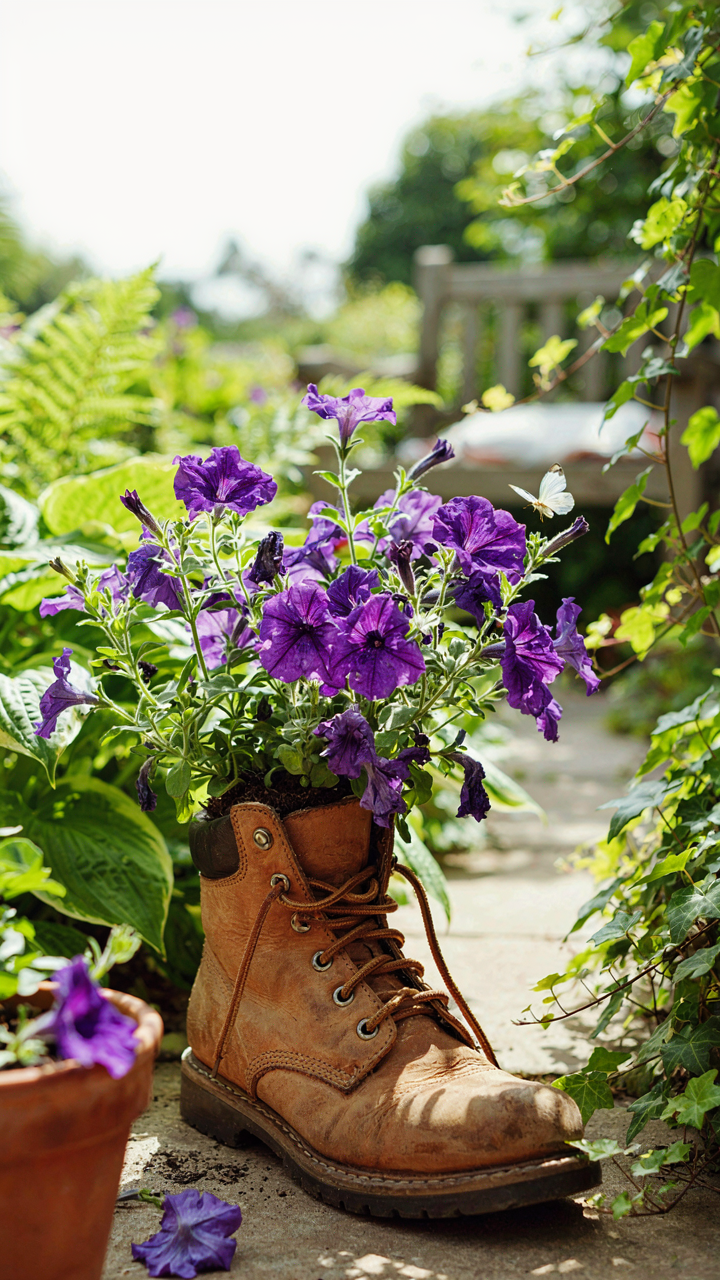
You want permission to keep something broken without feeling wasteful. Here’s what actually happens: boot planters work because they anchor memory in physical space. Psychology calls this environmental psychology—the study of how spaces shape behavior and meaning. A boot planter isn’t a decorative object; it’s a biographical marker. It holds a specific story nobody else owns. That’s the mechanism that separates lasting garden elements from disposable trends. The boot itself becomes a vessel for narrative, not just soil.

Your guests don’t connect with boot planters because they’re quirky. They connect because the object broadcasts authenticity in a landscape saturated with mass-produced lawn ornaments. Worn leather, weathered stitching, and actual use-damage create credibility. The planter says: this person didn’t follow a design magazine. This person chose meaning over matching. That signal is impossible to fake with store-bought novelties, and it’s exactly why people remember your garden instead of forgetting it in three weeks.
The Difference Between Seasons And Statements
Everyone recommends rotating seasonal decorations. That’s the trap. Seasonal swaps create visual noise and mental friction—you’re constantly replacing instead of building. Boot planters dodge this entirely because they operate on a different timeline. A worn Carhartt boot holding perennials transforms through the year without requiring removal. Spring growth, summer bloom, fall color, winter structure—the boot contextualizes all of it. One object, four seasons, zero waste.
The real distinction is permanence versus performance. Temporary garden accents rely on novelty to hold attention. They fail the moment someone sees them twice. Old boot planters don’t fail because they’re not trying to perform. They document time. A boot seasoned by decades of wear actually gains aesthetic weight as seasons pass through it. The mechanism is simple: consistent presence builds familiarity, familiarity builds attachment, attachment justifies the space the object occupies. That’s how a used work boot becomes unmissable.
The Boot Plant Protocol: From Discard To Distinction

Choosing Footwear That Commands Attention
You want this to look intentional, not like you’re broke. The mechanism is simple: scale and material contrast determine whether a boot planter reads as design choice or trash. Larger boots from work wear—logging, farming, military—create visual weight that smaller dress shoes can’t match. The leather needs visible character: creasing, patina, worn heel counters. These details signal history, which is the actual product you’re selling.
Vintage work boots outperform newer ones because their proportions sit between sculpture and utility. A 1970s or 1980s logger’s boot has a defined silhouette that photographs well and holds soil without collapsing. Avoid novelty boots, ballet pointe shoes, or anything with synthetic mesh. The material must be thick enough to stay structurally sound for two to three seasons. Brown and black leather boots create the strongest visual impact against green foliage.
Preparing Boots For Soil And Water
Most guidance here is incomplete. People drill drainage holes and call it done. That’s why their planters rot or develop smell within one season. The real protocol requires three steps before soil touches leather: seal the interior with a food-grade linseed oil or acrylic sealant, which prevents rot and extends usable life. Then perforate the sole deliberately with a half-inch drill bit in four to six spots for water escape. Finally, line the interior with landscape fabric so soil doesn’t wash through the drainage holes and expose the leather prematurely.
The boot stays structurally sound longer when water moves through soil to drainage points, not when water pools inside the leather itself. Use well-draining potting mix, never garden soil, which compacts and holds moisture against the inner walls. Check the sealant layer before the second season and reapply if cracking appears. This maintenance step separates boot planters that last from ones that become eyesores in eighteen months.
Upcycle Old Cowboy Boots: An Act Of Horticultural Subversion
The Boot As Identity Statement
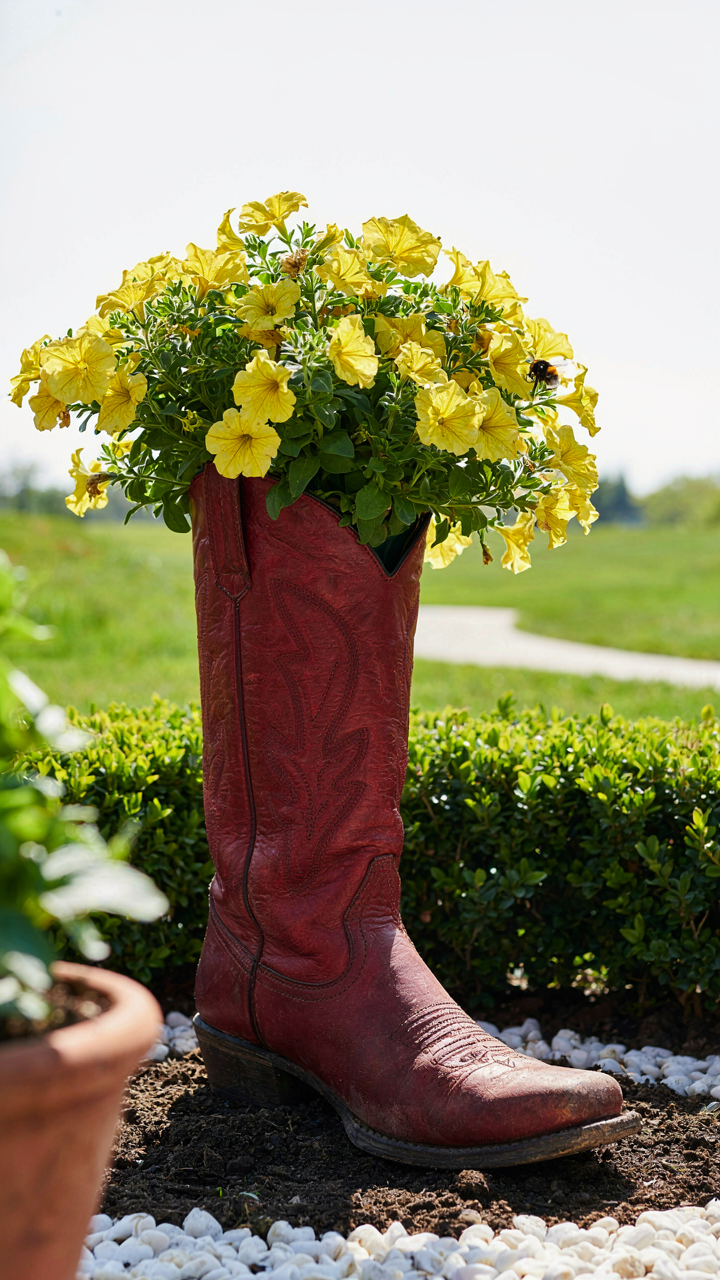
You want people to notice your garden because you’re tired of blending in. The cowboy boot as a planter works because it carries genuine cultural weight, not manufactured aesthetic. Boots signal work, wear, history. When you plant petunias in one, you’re not decorating—you’re making a deliberate choice to occupy visual space with something that doesn’t apologize for existing.

The boot’s form already communicates ruggedness. Its leather creases from actual use. Drainage holes punched through the sole don’t erase that narrative; they extend it. The planter becomes proof that utility and beauty aren’t enemies. This is why the generic terracotta pot fails here—it signals nothing but absence of opinion. A boot signals someone made a call.
Defiance Through Weathered Materials
People dismiss this as “cute upcycling,” which misses the actual mechanism at play. In semiotics, objects accumulate meaning through their history of use. A boot worn thin by actual walking carries cultural load that new objects cannot manufacture. When you repurpose it, you’re not being trendy—you’re refusing disposal culture’s premise that objects lose value after their original function ends.
This stance runs counter to planned obsolescence. Fast fashion discards boots after one season. You keep one. You fill it with soil. You make it produce. The statement isn’t subtle, and it doesn’t need to be. Place the planted boot where visitors see it first. The conversation it generates comes from the viewer recognizing they’ve been conditioned to throw things away.
Flowers In A Boot: Mastering The Art Of Intentional Contrast
The Color Mechanism Behind Boot Combinations
You want your boot planter to stop people mid-stride because it proves you have taste. That’s the real driver here. The mechanism is simple: color opposition forces the eye to work. Boot planters sit low in yards. They compete for attention against lawn, mulch, and house siding. Monochromatic plantings get absorbed into background noise. You need opposition to create visual weight.

Color theory borrowed from painting and design tells us that complementary colors (opposites on the color wheel) generate maximum contrast without looking broken. A rust-colored boot planted with deep purple petunias creates stop-power because those colors demand each other’s presence. The boot itself becomes a neutral container. The plants become the statement. When you reverse this and use analogous colors (neighbors on the wheel) like coral and orange, the boot reads as one unified form instead of a focal point.
Plant Shape Against Boot Form
The boot’s geometry is rigid and irregular simultaneously. Its calf tapers. Its sole flattens. Plant texture creates dynamic tension when you work against that fixed shape instead of echoing it. Spiky, upright plants in round boots feel wrong. Round, mounding plants in tall boots feel unresolved. This is not preference. It’s spatial mechanics.
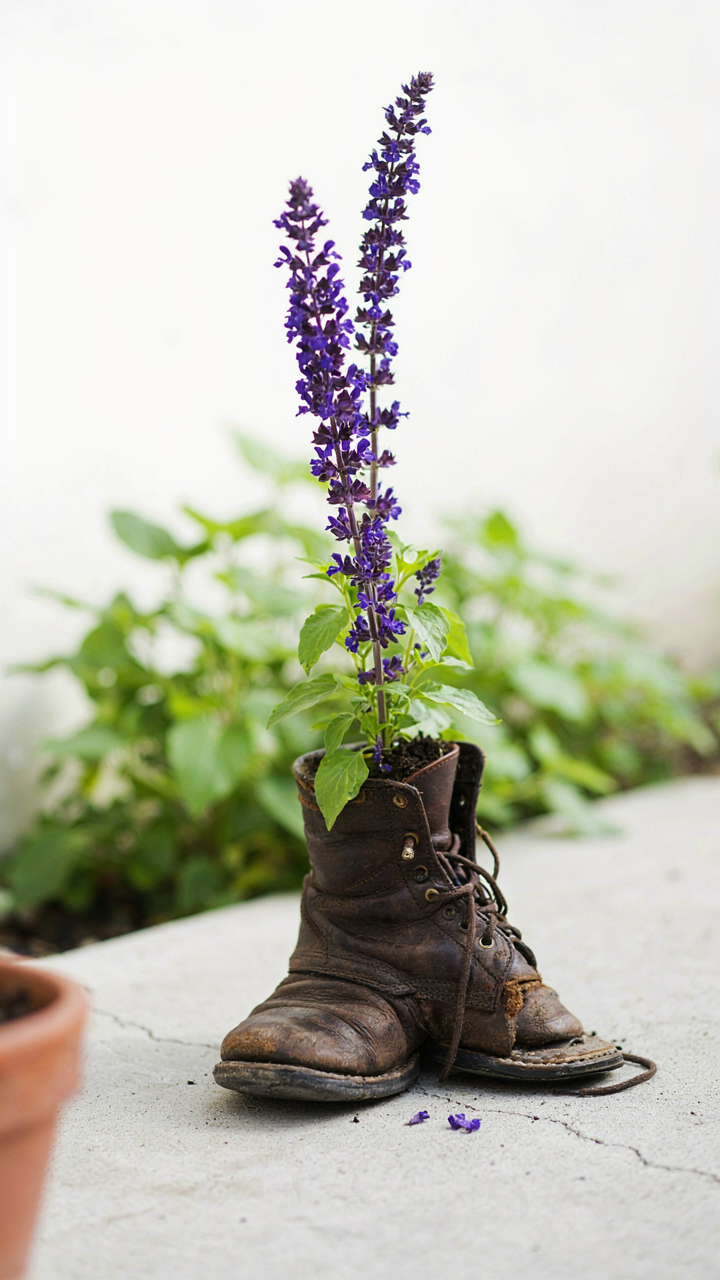
Trailing plants like creeping jenny or sweet potato vine spill over boot edges and counteract the boot’s grounded weight. Vertical spikes like salvia or ornamental grass create a visual arrow that points beyond the container itself. Feathery textures like asparagus fern soften the boot’s hard edges while their delicate form proves the planter is intentional, not accidental. Pair the boot’s form directly against plant form. The tension between them is what makes people notice.
Old Boots Turned Into Flower Pots: An Evolutionary Design
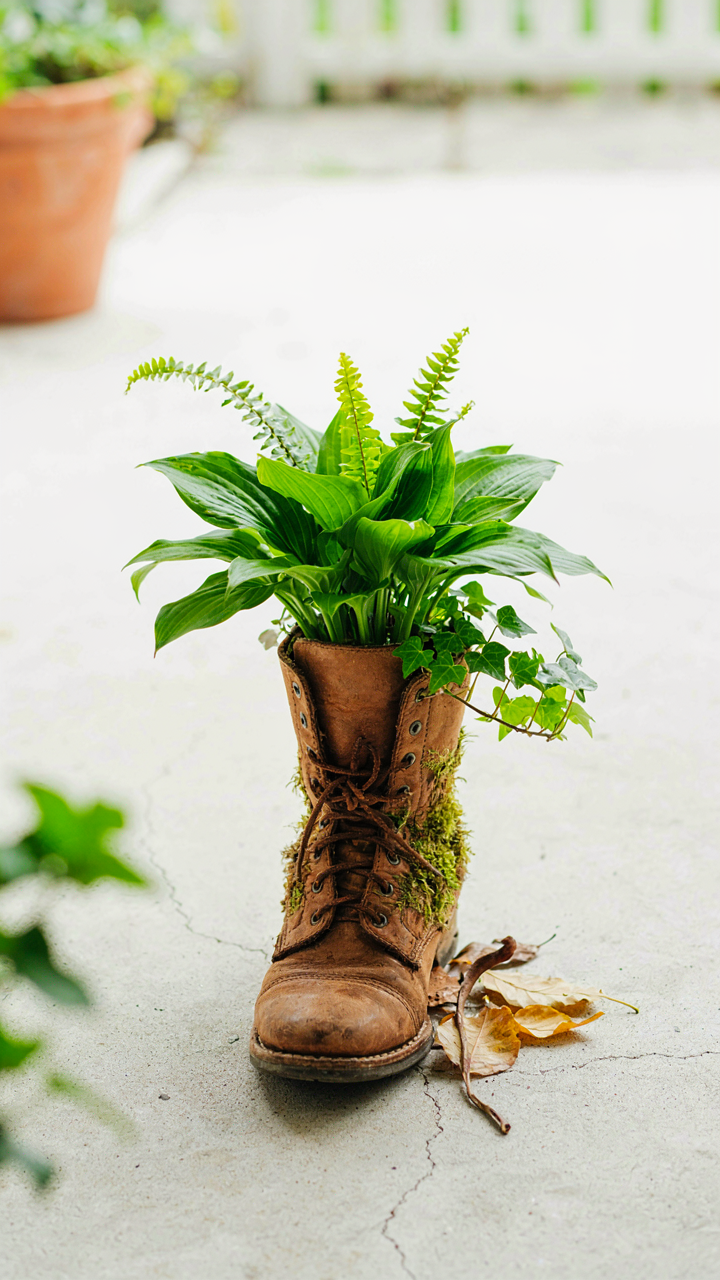
How Gardens Select What Survives
You want permission to keep something ugly because it has meaning. That’s the real mechanism here. But evolutionary biology explains why old boot planters work: garden aesthetics don’t follow rules imposed from above. They follow selection pressure. Gardeners keep and repeat what solves a problem or triggers recognition. The boot planter survives not because it’s beautiful by design magazine standards, but because it signals resourcefulness and history in a way new plastic pots cannot replicate.
Natural selection in gardens operates differently than in nature, but the principle is identical. Gardeners repeat designs that offer utility plus cultural resonance. Old boots have both: they drain well, cost nothing, and carry narrative weight. This combination creates positive selection pressure. Over time, boot planters appear in more gardens because they win on two fronts simultaneously. The design persists not through marketing or trend cycles, but through actual use and word-of-mouth adoption by people solving real problems.
The Boot, The Plant, And The Soil Economy
Ecology teaches us that survival depends on relationships, not isolation. Apply that framework to boot planters: the boot functions as both barrier and participant in a three-way system with plant and soil. The leather or canvas creates a permeable container that moderates moisture retention better than solid surfaces. It breathes in ways rigid pots don’t. The plant roots benefit from this gas exchange. Soil microbes maintain activity in the gaps and weaves of the material. The boot itself decays slowly, adding organic matter as it breaks down.
- Moisture regulation through fabric decay: Degrading boot material wicks water inconsistently, creating micro-droughts that force plant roots to develop deeper networks faster than uniform potting soil allows.
- Microbial colonization pathways: Worn leather and canvas provide entry routes for beneficial fungi and bacteria that establish faster than in sealed plastic containers.
- Structural integrity during transition: Boots maintain shape for 2-3 seasons before significant breakdown, giving plants time to establish before the container shifts its role from containment to compost.
- Thermal variance from material: Canvas and leather absorb and release heat differently than ceramics or plastics, moderating root temperature swings in exposed garden positions.
- Nutrient cycling from leather breakdown: As boot material decays, it releases nitrogen compounds that supplement traditional fertilizer cycles, particularly in poor garden soils.
The boot planter succeeds because it refuses to be static. It participates in decay. The plant doesn’t fight the container. Instead, both move through stages of productivity together. When the boot finally disintegrates, you don’t remove a failure. You remove a completed cycle.
Boot Planter Ideas: Beyond The Basic Container
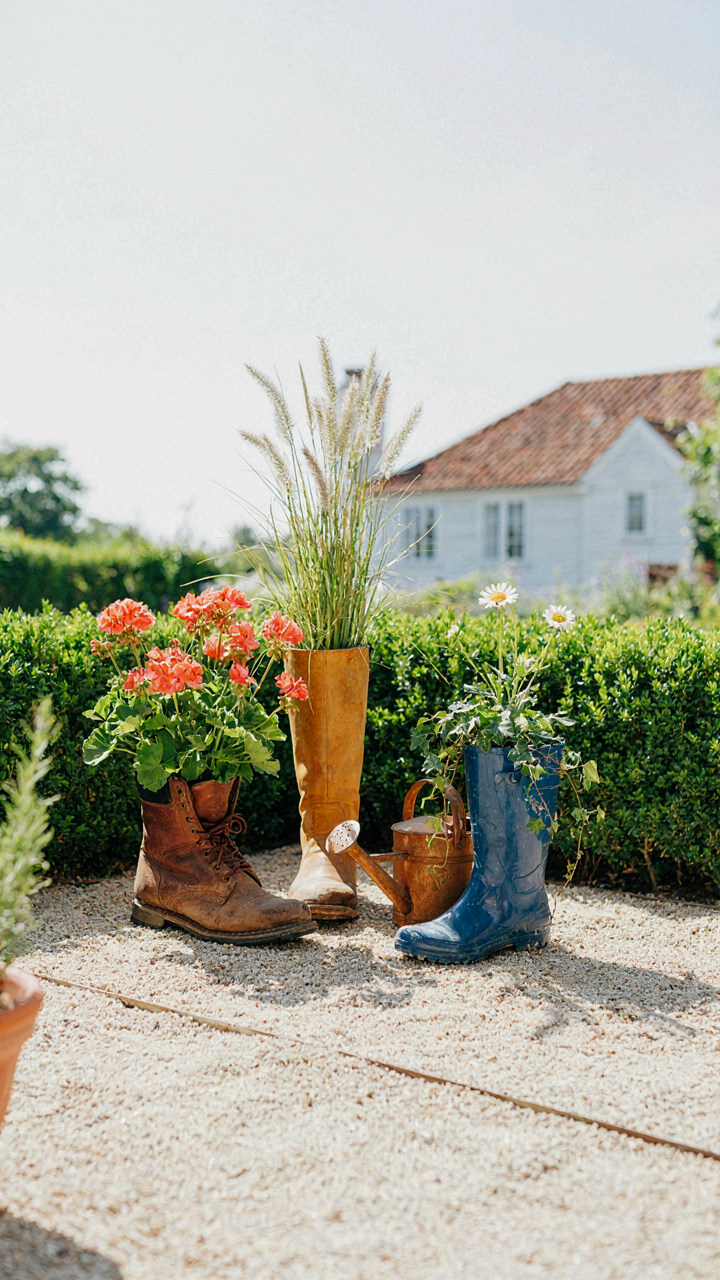
Placement That Stops People Mid Walk
You want your boots to feel discovered, not just sitting there. The real mechanism is contrast—boot planters work because they break the visual pattern your eye expects in a given zone. A weathered leather boot planted with succulents on a formal garden path reads as intentional oddity. That tension is what makes it memorable. Most people scatter boots randomly and call it rustic. That’s the trap.
Placement works when you anchor it to a threshold or pivot point. Position boots at a garden corner where sight lines meet, beside a gate entrance, or on a step where foot traffic naturally pauses. The boot becomes a signal, not decoration. This leverages what designers call compositional weight—placing an unexpected object where the eye already stops creates recognition without feeling forced.
Clustering Boots Into A Narrative System
The mistake is treating each boot planter as independent. Boot planters gain authority through intentional grouping. Boot clusters work like typography in design—odd numbers feel natural, even numbers feel accidental. Three or five boots arranged by height or color creates visual hierarchy. Two boots look like you forgot one.
Group boots by era if you source them differently—vintage work boots separate from newer styles. Vary planting heights so some boots spill trailing plants while others hold upright specimens. This creates depth. Stagger the clusters across your garden perimeter rather than bunching them in one area. The repetition across space makes the concept readable instead of looking like you stored them there.
Old Boot Planter: The True Measure Of Garden Authenticity
Resourcefulness Over Receipt
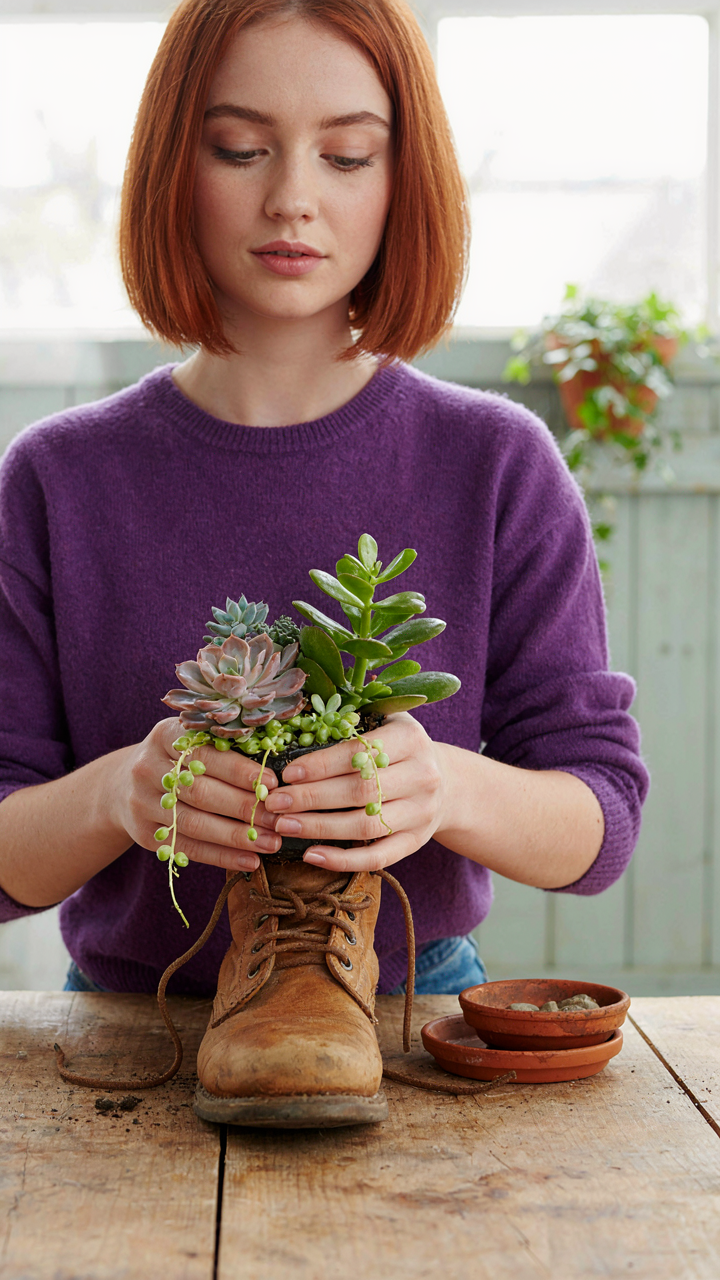
You want people to assume you’re cultured enough to reject mass-produced garden decor without trying. The mechanism is simple: boot planters signal you source materials with intention, not convenience. You didn’t order from a catalog. You found something with history, repurposed it, and made it work. That’s the real distinction. Most garden design advice tells you to buy matching sets or follow color themes. Wrong. A worn leather boot holding succulents reads as deliberate. It reads as someone who understands materials have stories. The work isn’t in purchasing. It’s in the hunt, the cleaning, the placement decision. That’s where authenticity lives.

Boots themselves are labor artifacts. They’ve been worn. They’ve moved through real use before they reach your garden. This history is what mass production erases. When you plant in an old boot, you’re not decorating. You’re extending an object’s functional life. That distinction matters because it reveals your actual values about consumption and waste. The resourcefulness shows not in the aesthetic choice but in the refusal to treat a worn item as trash.
The Weight Of Broken Patterns
Unconventional choices compound over time in ways that match compound interest from economics. Small decisions accumulate into systems. A single boot planter is decoration. A garden built on repurposed materials becomes a garden that teaches. Every visitor notices something that doesn’t fit the template. That disruption is intentional design. Most gardeners follow the same playbook: ornaments from garden centers, uniform planters, predictable arrangements. Those gardens don’t age well. They look dated because they’re locked into one commercial moment. Boot planters age differently. They deepen.
The long-term impact reveals itself in how your garden responds to time. Materials weather authentically. Leather cracks and fades. Metal components rust. These aren’t failures. They’re the garden documenting its own history. In five years, your boot planters tell a story about seasons and exposure and neglect and care. A purchased ceramic planter from a big box store tells you nothing except that it was available in 2024. When you commit to unconventional materials, you commit to a garden that becomes more distinctive every year, not less. The mechanism that drives this: authenticity compounds because it’s based on reality, not trend cycles.
Your Garden Isn’t A Showroom; It’s A Testament To Your Defiance. Stop Chasing Fleeting Trends And Cultivate Genuine Character
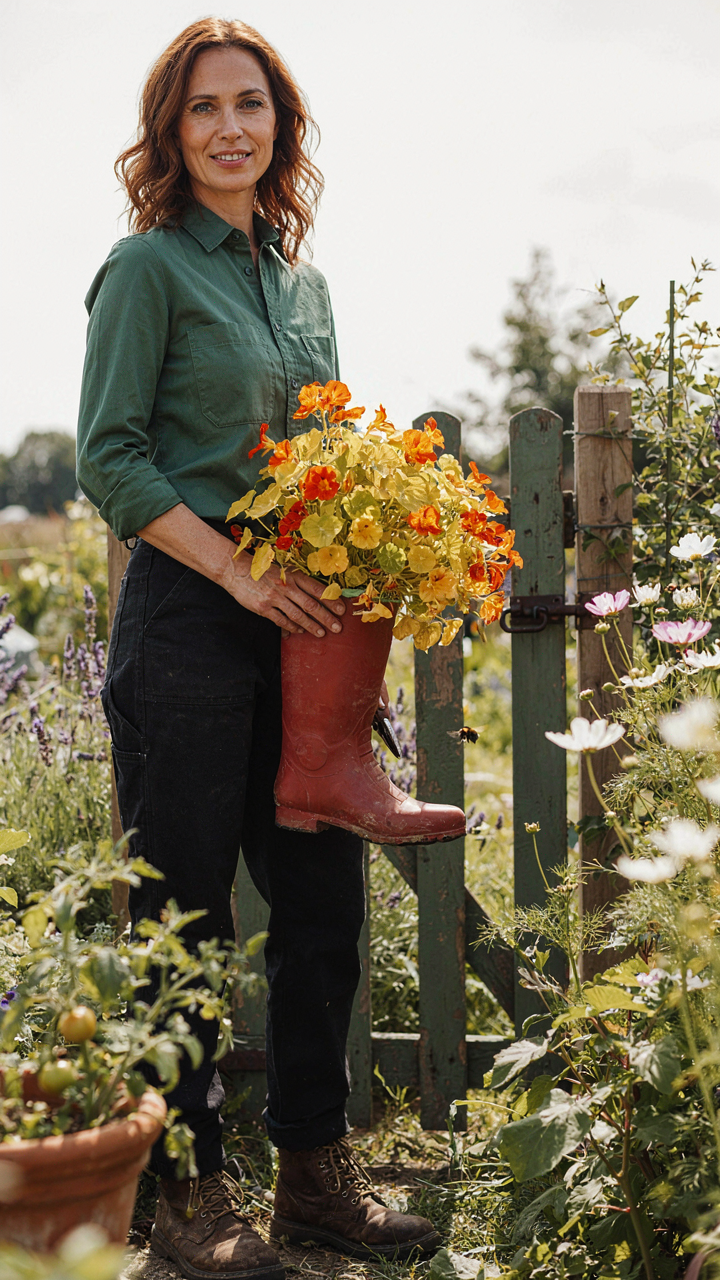
Most people kill their gardens trying to impress neighbors who don’t care. Old boot planters win because they reject that lie. They say you value authenticity over approval. Find three old boots in your garage or a thrift store today and plant them. Stop waiting for permission to make something real. Your garden proves something the rest of your life whispers: you’d rather be interesting than normal.