The Dirt Dogma Debunked: Why Your Hugelkultur Fails

Decomposition Isn’t A Timeline, It’s A Thermodynamic Problem
You want to believe that burying wood in your bed creates this magical slow-release nutrient factory for years. The hidden motive is comfort: a set-it-and-forget-it system that rewards patience instead of forcing you to manage nitrogen cycles. That’s not how decomposition works. Thermodynamics governs the rate. Wood breaks down only when three conditions align: sufficient nitrogen, adequate moisture, and oxygen availability. Miss one, and the process stalls completely.
Most people bury wood then assume microbial activity happens automatically. It doesn’t. Buried wood in anaerobic conditions becomes a carbon sink, not a nutrient source. The microbes that decompose cellulose and lignin require active nitrogen to build their biomass. If your hugelkultur bed contains only aged wood and compost without a deliberate nitrogen source layered in, decomposition slows to decadal timescales. You need to inoculate the wood core with nitrogen-rich material, not just stack it and wait.
More Organic Matter Becomes Nitrogen Theft
The common advice says load your hugelkultur with as much wood and biomass as possible. This is incomplete at best, destructive at worst. Applying excess organic matter without accounting for the carbon-to-nitrogen ratio starves your growing plants of available nitrogen during the critical first two years. This is microbial economics: as decomposers work through high-carbon materials, they immobilize nitrogen from the surrounding soil to fuel their own growth. Your plants compete against billions of microorganisms and lose.
A hugelkultur bed overstuffed with wood and aged compost without fresh nitrogen amendments creates a nitrogen deficit precisely when seedlings need it most. The solution isn’t more material, it’s balance. Layer nitrogen-rich components directly against the wood: fresh manure, grass clippings, or nitrogen-fixing plant matter. This ensures microbes have fuel to decompose the carbon while nitrogen remains available for plant uptake. Overloading a bed guarantees two seasons of stunted growth while the soil biology catches up.
The Unseen Enemy: Waterlogging And Oxygen Deprivation In Hugelkultur Garden

When Drainage Fails You
You want hugelkultur to work because you’ve read it solves drainage problems forever. That’s the fear talking. Here’s the mechanism: hugelkultur relies on wood decomposition to create air pockets that move water down and oxygen through the bed. When that wood breaks down too fast or compacts under its own weight, those pockets collapse. The bed becomes a sponge instead of a sieve. Anaerobic bacteria take over. Your soil suffocates from the inside.

Waterlogging in raised beds follows the same principle as battlefield supply lines: you need constant flow. Stagnant conditions create dead zones. In hugelkultur beds, standing water signals one problem: your drainage layer failed. This happens because most builders bury logs without understanding that wood size, type, and arrangement determine how long oxygen moves through the system. Hardwoods rot slower than softwoods. Logs stacked parallel trap water differently than logs stacked crisscross. Dense clay soil above accelerates compaction. Check your bed’s perimeter and bottom. Water pooling at the base means your foundation materials shifted or weren’t coarse enough to shed moisture.
Root Rot: The Architecture Problem
Conventional advice says root rot comes from overwatering. Wrong. Overwatering reveals that your hugelkultur bed’s internal structure cannot process the water volume you’re adding. Root rot is an architecture failure, not a watering mistake. The roots die because they sit in oxygen-free zones. Bacteria consume the root tissue. The decay accelerates. By the time you notice wilting, the damage extends deeper than you can fix by changing your irrigation schedule.
The timing matters here. Hugelkultur beds are most vulnerable during the first two years when wood still occupies most of the volume. As decomposition advances, the bed settles and compacts. This compression squeezes water upward and suffocates lower roots. You’ll see yellowing leaves, stunted growth, and a sour smell from the soil. Pull a plant and inspect the roots. Black, mushy tissue means anaerobic bacteria established colonies weeks ago. Once root rot starts, the plant rarely recovers in the same season. Prevent it by ensuring your wood base includes chunky material like branches and twigs alongside logs. These create channels that persist even as larger wood decays.
The Koe Protocol: Minimalist Hugelkultur Raised Beds Construction

Wood Selection By Decay Rate
You want to believe untreated wood lasts forever. It doesn’t. The real motive here is avoiding the labor of replacing your bed in five years, and that means understanding lignin breakdown, which is just wood’s version of oxidation. Softwoods like pine and spruce decay fast because their cell structure breaks down under moisture and microbial attack. Hardwoods like oak and cedar resist this because their density slows water penetration and their natural tannins inhibit rot. The trade-off is cost and availability.

Cedar lasts eight to fifteen years. Oak stretches that to twenty. Pine gives you three to seven before structural failure. The mechanism matters because hugelkultur beds sit in constant contact with moisture from below and internal composting heat from above. This isn’t a raised bed that dries out between waterings. You’re creating a biological furnace. Cedar or oak aren’t luxury choices; they’re the only rational choice if you want to avoid dismantling and rebuilding.
Layering For Water Movement, Not Mythology
Common advice says layer kitchen scraps, then leaves, then soil, and somehow nutrients magically appear. That’s incomplete. The real function of layering is capillary action and air gaps, which is fluid mechanics applied to soil science. Coarse materials at the bottom create void space that channels water downward instead of pooling. Fine materials compact over time and trap moisture where roots actually need it. You’re not stacking ingredients like lasagna; you’re engineering a percolation path.
Start with branches or wood chunks at least two inches diameter. These don’t decompose quickly and create the structural channels that prevent waterlogging. Layer coarse compost or aged manure above that, then smaller woody material, then finished compost at the top where plants feed. The spacing matters more than the ingredients. Compacted layers kill hugelkultur. Test your layers by pouring water through them; it should drain within thirty seconds if you’ve built it right. Stagnant water means fungal disease and root rot regardless of how much compost you added.
The Black Box Of Decomposition: Bioavailability Of Nutrients

Microbes Control The Release Schedule
You want to believe nutrients are just sitting there waiting to be absorbed. They’re not. Microbial action determines whether locked carbon becomes available nitrogen or stays trapped for years. Decomposition isn’t passive breakdown—it’s a transaction between microbes and organic matter. Bacteria and fungi extract energy from carbon compounds, then excrete the byproducts your plants actually use. No microbes, no availability. The system stalls.

In hugelkultur raised beds, the wood core creates extended microbial habitat. Fungi colonize wood for months or years, releasing nutrients gradually as they consume the cellulose and lignin. This isn’t better because it feels natural—it’s better because it extends the feeding window. A traditional raised bed burns through compost in one season. A hugelkultur bed feeds plants progressively through decomposition stages, each supporting different microbial communities and nutrient profiles.
Nitrogen Immobilization Is Real And Manageable
Most advice about hugelkultur sidesteps this: high carbon materials lock nitrogen temporarily. If your bed has mostly wood chips and sawdust, microbes will consume available nitrogen to break down that carbon. Your plants starve while the microbes work. This is nitrogen immobilization, and it’s not a flaw to accept—it’s a dynamic to engineer around.
The solution isn’t avoiding carbon-rich materials. It’s balancing input ratios strategically. Layer high-nitrogen materials—fresh manure, grass clippings, food scraps—directly against the wood core. Microbes will use that nitrogen to kickstart wood decomposition, then release it back into the soil matrix as their populations stabilize. A properly built hugelkultur bed front-loads nitrogen to fuel the very process that would otherwise steal it.
How To Build Hugelkultur: Ignoring The Guru’s Grand Design

Start Small And Dig Nothing
You want permission to build something impressive without the work. Here’s the mechanism: complexity kills execution. Most hugelkultur raised beds fail because people follow permaculture designers who treat them like art installations. You don’t need intricate layering systems, precise slopes, or aesthetic arrangements. You need rotting wood, soil, and time. Start with a single bed, six feet by three feet, eighteen inches deep. This teaches you the actual system.

The standard advice says buried wood creates long-term nutrient release and air pockets. That’s true but incomplete. It also means you’re fighting compaction for years while that wood breaks down. A smaller bed lets you observe decomposition speed, drainage patterns, and soil structure changes without betting your season on an untested design. Build one. Document what happens. Then scale.
Leverage Your Body, Not Your Back
Physics calls this mechanical advantage. Hugelkultur raised beds call it the difference between staying healthy and blowing out your lumbar spine. A broadfork does one thing: it moves earth by redirecting downward force into lateral fracturing instead of vertical lift. You push down on long handles, and the tines spread the soil below without pulling it up. Most people dig, which means repeated loaded spinal flexion.
Position yourself at the edge of your bed outline. Push the broadfork handles down slowly until the tines reach full depth. Step back. Rock the handles toward you. Move forward two feet. Repeat. This takes three times longer than shoveling but preserves your body for the actual building work. You’re breaking the soil’s resistance before you move it, not moving resistance itself.
The Myth Of Instant Gratification: Hugelkulture Gardening Timelines

Your Bed Will Sink, And That’s The Point
You want to build it and harvest tomatoes like you’re some suburban farmer within weeks. That’s the real tension here—the gap between effort invested and results visible. Hugelkultur operates on thermodynamic principles: decomposition generates heat and settles material vertically over time. The bed doesn’t fail when it sinks. It’s decomposing exactly as designed. Wood breaks down. Soil compacts. This isn’t a problem to solve. It’s the mechanism doing its job.

Most hugelkultur guides skip the settling phase entirely, which creates false expectations. Year one, your bed drops 6 to 12 inches depending on wood type, initial moisture, and layering density. Softwoods decompose faster than hardwoods. A bed built with pine settles more aggressively than one built with oak. You account for this by building 2 to 3 feet tall initially if you need a specific finished height by planting season. Measure where you want to plant, then build taller to compensate.
First Year Yields Versus Actual Soil Building
The temptation is to expect full productivity immediately. You won’t get it. Your first-year harvest will be decent but unspectacular compared to year two and beyond. The reason is straightforward: hugelkultur builds soil carbon and microbial activity as wood decomposes. That process accelerates after the first season, not during it. Early yields come from the compost layer and existing amendments you added. Actual soil improvement compounds in years two through five.
This isn’t a selling point for marketing. It’s the trade-off you’re making. You sacrifice immediate output for long-term soil structure, water retention, and nutrient cycling that lasts a decade or more. If you need maximum production in season one, amend aggressively with finished compost and aged manure in the planting layer. If you’re building for sustained productivity with minimal external inputs, accept that year one is the learning phase where your soil does the actual work.
How To Make A Hugelkultur Bed: Site Selection And Microclimates

Sun Exposure: Adapting To Your Garden
You want to skip the site selection work because it feels obvious, but this is where most people waste a season of growth. Sun exposure is a physics problem: photosynthetically active radiation hits your bed at different angles and intensities depending on latitude, season, and obstruction. Your hugelkultur bed doesn’t change this equation, but its thermal mass does change how plants respond to it.

Most gardens get 4 to 6 hours of direct sun where vegetables actually thrive. Less than that, and your decomposition slows because the internal wood decay depends partly on ambient temperature. More than 8 hours of summer sun in hot climates can stress shallow-rooted seedlings before they tap into the cooler, moister wood layers below. Measure your site’s actual sun hours across spring and fall using a sun calculator app or simple daily observation. Orient your bed to catch morning sun in cold climates and afternoon shade in hot ones. The bed’s height means plants experience hotter soil than ground-level gardens, so adjust for your climate accordingly.
Wind Protection: Strategic Bed Placement
Wind isn’t just discomfort for plants, it’s a water loss mechanism that drains your bed’s moisture faster than rain or irrigation can replenish it. You see this plainly in windy gardens where even well-watered plants wilt by afternoon. Place your hugelkultur beds where existing structures or trees break prevailing winds without creating frost pockets or blocking sun entirely. North-facing placement near a fence or hedgerow works for most temperate regions. South-facing open placement works if your climate’s wind patterns run north to south and you need maximum solar gain.
If your site has no natural wind breaks, you can build them after placement, but that’s reactive. Plan bed placement before you build. In exposed areas, orient the bed’s length perpendicular to prevailing wind to minimize the wind-facing surface. The raised height of a hugelkultur bed makes it more vulnerable to drying than sunken beds, so wind protection directly affects your watering schedule and soil moisture retention throughout the growing season.
Beyond Raised Beds: The Permaculture Principle Applied
Water Harvesting Through Contouring And Swales
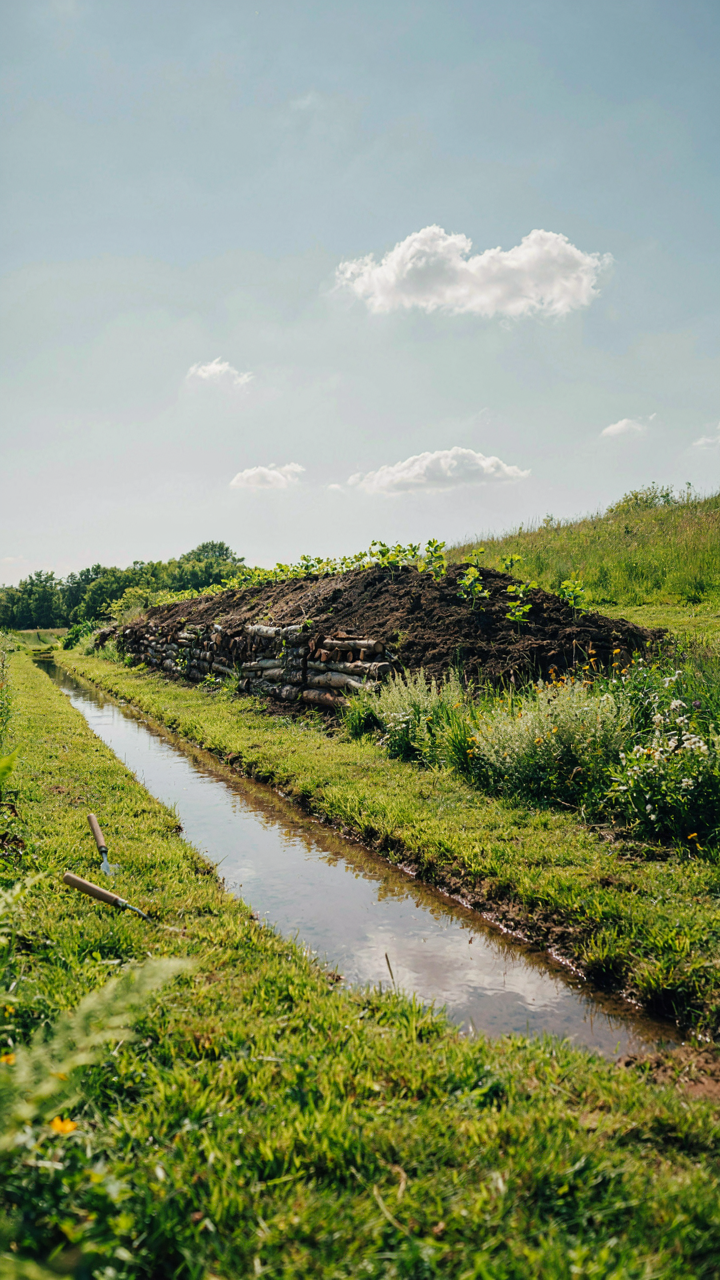
You want to believe your hugelkultur bed is self-sufficient. It isn’t. The real move is treating water as a design problem, not a maintenance task. Hydrology gives us the term “flow.” In landscape design, flow means capturing water before it leaves your property. A hugelkultur bed without swales captures only what falls directly on it. The buried wood extends moisture retention, but you’re leaving free water on the table.

Contour lines follow elevation at the same height. Swales are shallow trenches dug along these lines to slow and sink water. Position swales upslope of your hugelkultur beds. Water moves downhill, so swales catch runoff and force infiltration before it reaches your bed. This means your bed stays fuller longer without you hand-watering. The wood inside the bed then acts as a wick, pulling that stored water upward as soil dries. This is the actual mechanism: swales pre-charge the system so the wood can do its job.
Stacking Functions Into Integrated Systems
Every system you add steals attention and energy. Permaculture uses “stacking” to solve this: one design element serves multiple purposes simultaneously. Economics calls this resource efficiency. Your hugelkultur bed is already stacking water storage and soil building. Extend it by running perennial plantings along its length to provide edge habitat for predatory insects. The bed structure becomes a windbreak. Nutrient cycling intensifies. You move from “I built a planter” to “I built an ecosystem that feeds itself.”
The protocol is simple: map what your bed already does, then list what else the space touches. Does it border a path? Make the edge functional as a step or bench. Does it catch afternoon sun? Plant nitrogen fixers on the north side to shade the soil. Does water runoff concentrate near it? Design a small basin to direct that flow. Each addition must reduce total labor, not increase it. This compounds over seasons as the wood breaks down faster, the soil deepens, and your work per square foot drops.
The Unspoken Truth About How To Build Hugelkultur Beds

The Real Cost Of Year One Neglect
You want hugelkultur to feel like a set-it-and-forget-it soil solution. It isn’t. Most people abandon their beds in month four because the actual work doesn’t match the marketing. The wood core stays wet far longer than expected, nitrogen drawdown starves surface crops, and settling creates gaps that trap water. You have to actively manage decomposition, not just watch it happen.

Year one demands constant attention to nitrogen supplementation and soil amendment. Add compost heavily in spring. Monitor moisture on the perimeter where roots establish first. The wood core still contains woody material that needs years to break down, so crops planted directly above it will yellow before they thrive. This phase lasts 12 to 18 months, not the mythical “three seasons” people cite. Skip this maintenance and you’re debugging a failed experiment.
When A Pile Beats A Box
The advice to build contained hugelkultur beds misses a critical advantage of simple mounded designs. Using economics terminology, the contained bed creates artificial scarcity by limiting the perimeter where microbial activity accelerates decomposition. An uncontained mound exposes more surface area to air, water, and soil organisms, which speeds the biological process you’re trying to harness in the first place.
Mounds work better in temperate climates where moisture levels stay moderate and you have space to spread. They require zero materials, settle predictably, and the sloped sides dry faster than flat-bottomed beds. Contained beds make sense only when space is precious or you need to control water runoff on slopes. Most home gardeners choose boxes for aesthetics, then complain about the higher maintenance cost. Build a mound if you want faster decomposition and lower labor. Build a box if you need boundaries and don’t mind managing additional complexity for three years.
The Real Obstacle Isn’t Your Soil; It’s Your Addiction To Unnecessary Effort And Idealized Outcomes

Most people won’t build hugelkultur raised beds because they want the perfect setup before they start. They research endlessly. They wait for the ideal location, the right wood, the exact soil blend. Meanwhile, their garden stays imaginary. Hugelkultur works because it’s a system that improves over time, not one that demands perfection upfront. Grab whatever wood you have today, layer it, add compost, and plant. The soil will build itself. Your job is to stop planning and start burying.