The Myth Of “Coastal Chic”: Why Most Driftwood Decor Fails

What You’re Actually Buying When You Buy The Aesthetic
You want people to think you have taste without the work of developing it. Here’s the mechanism: coastal design became a template because it scales. IKEA sells it. Target stocks it. Pinterest serves it. The moment driftwood decor entered mass production, it stopped signaling anything except that you visited a store. Real coastal aesthetics came from constraint—people who lived near water used what washed up because nothing else was available. Today you’re paying for the look of constraint while avoiding any actual constraint. That’s the gap.
Most driftwood you see in stores never touched an ocean. It’s stained pine or reclaimed lumber sanded smooth and bleached. The problem isn’t that it’s fake. The problem is that fake driftwood follows rules. It has uniform color. It fits proportions that work in a warehouse. It matches your throw pillows. Authentic driftwood refuses to cooperate. It’s asymmetrical, weathered unevenly, heavier than expected, and rarely the shade you want. That friction is where design lives.
The Compression Between Real And Manufactured
Economics explains the gap here. In supply chain terminology, driftwood has high search costs—finding it takes time, travel, and luck. Manufactured alternatives reduce friction to zero. You click, it arrives Tuesday. But that frictionless transaction erases what made driftwood desirable in the first place. When something costs nothing to obtain, it signals nothing about you. It just signals you have a credit card.
The visual difference matters less than most people think. What kills a room of mass-produced driftwood isn’t that it looks fake—it’s that it looks inevitable. Three identical pieces arranged on a shelf say nothing. One genuine piece, placed with intention, says you have a standard. Start sourcing locally. Visit beaches after storms. Call local salvage yards. Buy from people who actually harvest, not distributors who warehouse. The extra effort is the point.
Beyond The Beach: Sourcing Real Driftwood (Not Craft Store Imitations)

What Actually Constitutes Real Driftwood
You want the real thing because buying it signals you didn’t take the easy path to coastal aesthetics. Here’s the mechanism: genuine driftwood has been tumbled by saltwater and sand for years, which creates a specific surface texture and structural weakening that craft store pieces simply cannot replicate. Real driftwood shows grain separation, salt bleaching patterns, and density loss from prolonged water exposure. The wood becomes lighter, develops a silvery patina, and loses its density in predictable ways based on species and submersion time.

The common mistake is confusing weathered painted wood or sanded pine with actual driftwood. Craft stores sell pre-bleached wood shaped to look driftwood-like, but it lacks the internal structural changes that come from saltwater saturation. True driftwood will have soft spots you can press your fingernail into. The wood crumbles slightly at edges. You’ll notice it feels almost chalky where waves abraded it most. Run your hand across authentic pieces and you sense the years of work the ocean did.
Legal And Practical Collection
Most beaches allow driftwood collection for personal use, but some protected areas restrict removal entirely. National parks, marine sanctuaries, and certain state beaches prohibit taking anything. Private beaches often ban collection without permission. Before heading out, check the specific jurisdiction’s regulations because enforcement varies wildly. Sustainability matters here: driftwood comes from dead trees already in the water, so collection doesn’t harm living ecosystems. You’re removing debris that would otherwise pile up or break down naturally.
The ethical baseline is simple: never collect from areas marked as protected habitat or nesting zones. Don’t strip bark from living trees washed ashore. Avoid pieces that clearly support current marine life like mussels or barnacles still actively feeding. Collect during low tide when access is safest and you can survey larger areas. Bring pieces home gradually rather than stripping a beach bare in one trip. This approach keeps beaches functional while giving you genuine material for your space.
The “Wabi Sabi” Method For Driftwood Decor Integration

Imperfection As The Actual Design Strategy
You want permission to stop trying so hard. Wabi-sabi, the Japanese aesthetic principle centered on accepting impermanence and incompleteness, operates like entropy in design: it removes the burden of perfection and replaces it with purposeful acceptance of what time has already done. Most decor advice tells you to hide flaws. That’s backwards for driftwood.
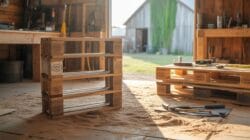
Driftwood arrives with cracks, weathering, discoloration, and irregular shapes. These aren’t problems to solve. They’re the entire point. A piece of driftwood with a smooth, unblemished surface is actually less valuable as decor because it hasn’t earned its story. The wood’s asymmetry and surface damage tell you exactly how long it survived in saltwater and sun. Place a gnarled branch vertically in a tall vase without trying to “balance” it. The imbalance makes it work.
Found Objects Carry Narrative Weight
The reason people respond to driftwood isn’t aesthetic nostalgia. It’s because a found object short-circuits the artificial nature of purchased decor. You didn’t commission it. You didn’t pick it from a catalog. Something transported it to a specific beach at a specific time, and you happened to be there. That collision of chance creates a psychological anchor that factory-made pieces cannot replicate.
When you integrate found driftwood into a room, you’re installing evidence of an actual experience. Pair a piece with a photograph of where you found it, or tell visitors the story once. The driftwood then functions as a physical bookmark for that moment. This is why generic decorative wood that’s artificially aged fails: it skips the narrative. The integration mechanism is simple: place found objects where they create conversation, not where they complete a color scheme.
Driftwood Art DIY: From Debris To Deliberate Statement

The Case For Leaving Things Alone
You want to feel like you made something, not like you just arranged found objects on a wall. Here’s the mechanism: constraint forces intention. The best driftwood pieces need almost nothing. A weathered branch already has form, patina, and the credibility of time. Your job is selection and placement, not transformation.

Sand a piece smooth and you’ve erased what made it valuable. The salt, the splits, the bleached color—that’s not damage. That’s documentation. Mount a single statement piece against white drywall or above a fireplace mantel. Let the wood’s existing geometry do the work. One piece dominates a room far more than a gallery wall of polished sentiments ever will.
Sculptural Form As The Anchor
Driftwood doesn’t follow industrial design principles—it follows physics. The grain, the weight distribution, the negative space carved by salt water—these are structural facts, not aesthetic accidents. A branch with a dramatic curve or a piece that naturally splits into two directions becomes your artistic anchor because the wood has already solved the hard part of composition.
Don’t sand these pieces. Don’t stain them. Mount them on stands, pedestals, or hang them in ways that emphasize their three-dimensional shape. A twisted root system or a weathered trunk section reads as sculpture because it occupies space with intention. The viewer’s eye moves through the void between arms and branches, following paths the ocean already carved. That’s the entire statement. Anything you add diminishes it.
Driftwood Wall Art: Elevating Vertical Space Without Clutter
The Focal Point Hierarchy
You want permission to hang one expensive piece and call it done. That’s not how focal points work. A focal point isn’t about size or cost. It’s about contrast. In visual hierarchy, focal points work like information architecture in design: you’re directing attention through strategic placement and relationship to other elements, not through isolation.

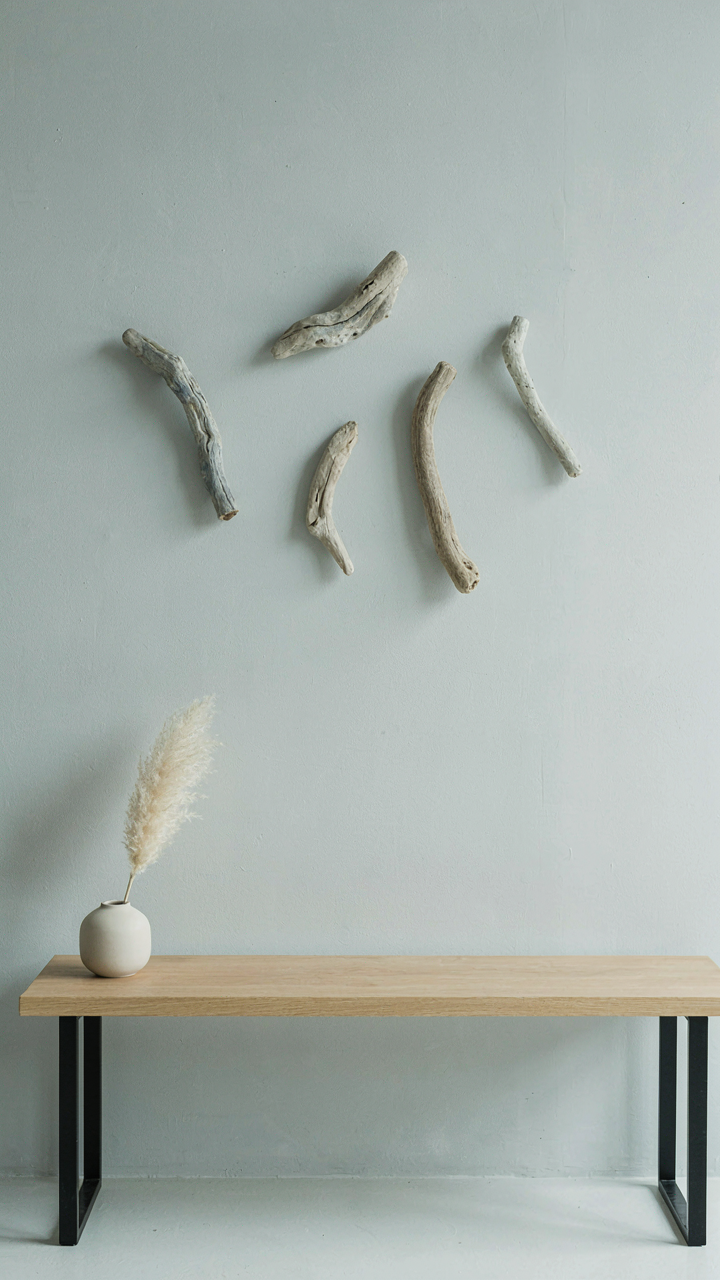
A single large driftwood piece dominates only if the wall behind it is empty and the room lacks competing visual weight. Most rooms don’t work that way. Curated arrangements of smaller pieces—typically three to five items at varied heights—create visual interest without the commitment problem of one massive statement piece. The arrangement itself becomes the focal point, not the individual wood.
Secure Mounting For Load And Texture
People assume driftwood hangs like a framed picture. It doesn’t. Driftwood is irregular, heavy in unpredictable places, and its surface won’t hold standard picture hangers. You need anchor points that match the wood’s actual weight distribution, not its apparent size.
Use heavy-duty French cleats rated for 30+ pounds minimum per cleat. Mount them directly into wall studs where possible. For pieces under five pounds on drywall, toggle bolts work. For larger work, always find studs. The wood’s density varies wildly depending on species and weathering, so err toward overbuilt hardware. Check mounting points monthly for the first three months to catch shifts before they cause damage.
The Biomimicry Principle: How Nature Solves Your Decor Problems

How Branching Creates Movement Without Clutter
You want your room to feel alive without looking chaotic. Here’s what actually works: branching patterns from biology—the same logic trees use to distribute weight and maximize reach—organize driftwood placement so your eye moves through space instead of getting stuck. The mechanism is hierarchical flow. One large piece anchors the wall. Smaller pieces radiate from it at varying heights and angles, mimicking how branches split from a trunk. This isn’t decoration. It’s spatial communication.

Most people dump driftwood into a corner and call it done. Wrong move. The branching principle works because your brain processes it as intentional rather than random. Place your primary driftwood piece at eye level or slightly above. Position secondary pieces so they appear to emerge from or lean toward the primary anchor. Tertiary pieces fill gaps without competing. The room gains visual momentum. Your eye traces a path rather than scanning dead weight.
Material Pairing Through Erosion Logic
Driftwood survives because it yields to pressure rather than resists it. This teaches material pairing: combine driftwood with substances that have opposing density profiles. The erosion process exposes driftwood’s softness against water and abrasion, making it the perfect counterpoint to dense, unchanged materials. Pair it with concrete, iron, stone, or glass. Each relationship works because contrast creates visual rest points. Your brain stops processing chaos and settles into rhythm.
Avoid the consensus mistake of pairing driftwood with rope, linen, and soft textiles exclusively. That reading feels incomplete, almost apologetic. Instead, let driftwood meet hard surfaces where it appears fragile by comparison. A driftwood shelf anchored to a blackened steel bracket creates tension. Driftwood branches in a clear glass vase let viewers see the void around the wood, emphasizing its form. The pairing works because erosion teaches us that materials speak through contrast, not similarity. Mount your driftwood against materials it would never find in nature beside it.
Driftwood Crafts DIY: Functional Pieces, Not Just Faux Finishes
Lighting Fixtures That Actually Work
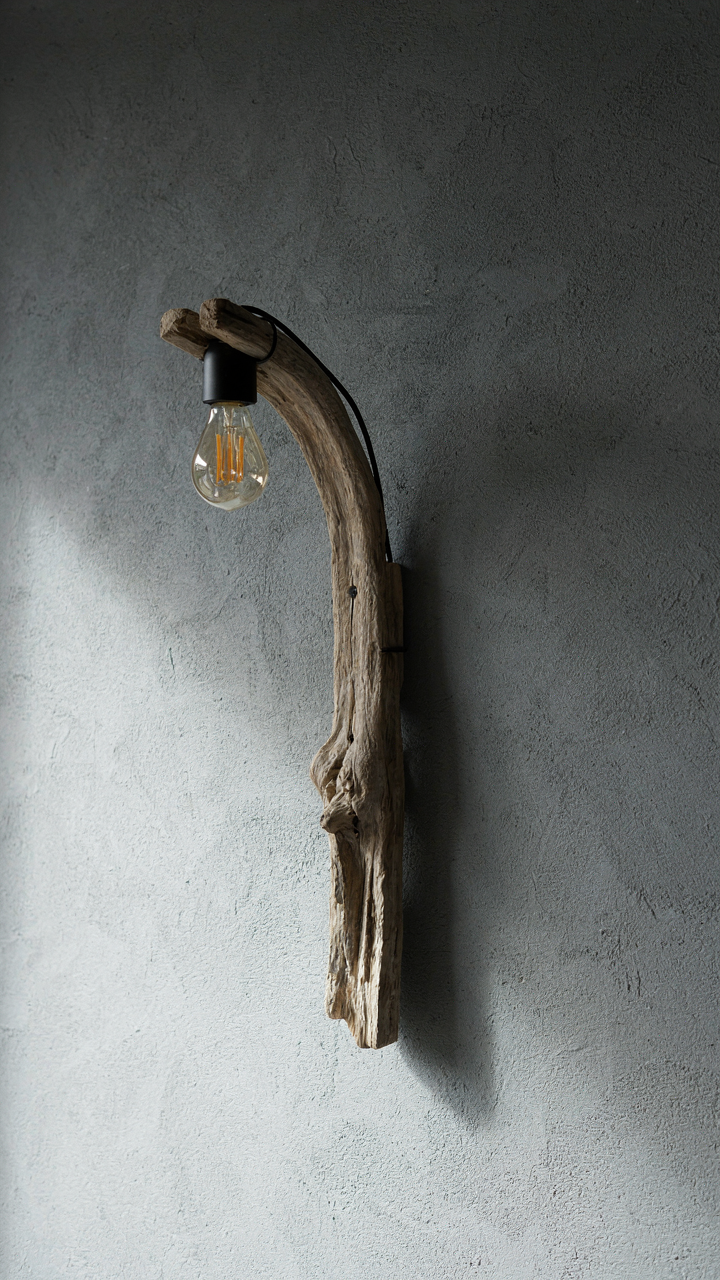
You want driftwood lighting because it signals you understand coastal design without trying too hard. Here’s the mechanism: light fixtures are the only decor objects people use daily, so they bridge the gap between aesthetic and utility. Treating driftwood as a structural material rather than decoration makes the piece worth keeping.

The real work happens in the engineering. Driftwood lacks uniform density, so weight distribution matters when you’re suspending it. You need to identify the grain’s direction and place your anchor points along the strongest axis. Run electrical through the piece rather than wrapping it around the exterior, which looks cheap and creates fire risk.
- Pendant lights with resin pours: Embed driftwood segments in clear epoxy before adding the socket. The resin stabilizes irregular shapes and creates a seal against moisture damage from salt air.
- Wall sconces using branch arms: Mount treated driftwood horizontally to hold Edison bulbs or fabric shades. The branch structure creates visual interest while keeping wiring hidden inside the piece.
- Chandelier frameworks: Use thicker driftwood sections as the central spine, then attach socket clusters to smaller branches radiating outward. This requires pre-drilling for weight distribution and proper electrical load calculation.
- Recessed driftwood surrounds: Frame recessed ceiling lights with thin driftwood pieces arranged in circular or linear patterns. This approach requires no structural load on the driftwood itself, just aesthetic positioning.
- Floor lamp bases with weighted cores: Hollow driftwood sections and fill with concrete or sand to create stable lamp bases. Seal the bottom completely to prevent moisture infiltration and shifting of interior weight.
The finish decision determines longevity. Salt air and humidity degrade untreated wood in months. Apply marine-grade polyurethane, which hardens the surface while allowing the wood to breathe underneath. Recoat annually if the fixture sits near windows or exterior walls.
Stands, Shelves, And Tables
Driftwood furniture requires actual structural engineering, not just stacking pieces together. Most people skip this and end up with unstable pieces that get shoved in storage. The difference is calculating load capacity before you build.
Tables and stands need a wide, low center of gravity. Position your heaviest driftwood pieces at the base, not balanced on top. For a side table, use a thick driftwood segment as the base and attach a reclaimed wood top using wooden dowels and epoxy, not visible fasteners. The joint needs to be stronger than the wood itself, or the whole piece fails under weight.
Shelving demands different logic. Horizontal surfaces need vertical support directly underneath. Cantilevered driftwood shelves look cleaner but fail if you underestimate the wood’s actual load rating. Mount shelves to wall studs, not drywall, and use galvanized brackets rated for your anticipated weight. A single decorative item is fine; a collection of books or ceramics requires industrial-grade support.

Real driftwood has already survived salt water and UV degradation. This means it’s often weaker than live-cut wood of the same diameter. Treat it like it’s 20 percent more fragile than its appearance suggests. Sand rough spots smooth, apply sealant, and test stability before placing anything valuable on top.
Integrating Driftwood With Rustic Homes: Beyond The Obvious

The Contrast Play That Actually Works
You want driftwood to feel intentional, not like you grabbed it off a beach and nailed it to the wall. The real mechanism here comes from industrial design: tension. Rough surfaces need polished opposition to register in the room instead of disappearing into visual noise.
Pair weathered driftwood with high-gloss surfaces. A bleached piece against matte black metal shelving. Raw wood next to lacquered concrete or polished stone. The eye catches the boundary between textures, and that boundary is what makes the piece visible. Without contrast, driftwood becomes background.
Natural Tones Done Right
Most advice says “use neutrals,” which tells you nothing and wastes your time. The real play is undertone matching. Driftwood carries specific color information: gray-silver, ash, bone white, or subtle tan depending on wood species and weathering time.

Map these undertones to your wall base and secondary surfaces. If driftwood reads gray-silver, pull that same undertone into your paint or plaster. Add accents in warm metals like copper or brass, or cool metals like brushed nickel. The driftwood doesn’t stand alone—it anchors a three-part color system. Buy your pieces first, then sample your walls against them.
The “Less Is More” Mandate: Strategic Placement Of Driftwood Decor

One Powerful Piece Over Many Mediocre
You want driftwood decor to signal taste without effort, which is why you’re tempted to fill every corner. Here’s the mechanism: your eye processes novelty, not quantity. A single sculptural piece of driftwood commands attention because it breaks the pattern of your room. Multiple pieces compete for that same attention and lose it entirely, creating visual static instead of a focal point.
The math is counterintuitive but proven in interior design practice. One large, texturally interesting driftwood branch placed deliberately on a mantle or leaning against a wall registers as intentional curation. Five smaller pieces scattered across shelves read as clutter, even when each one is objectively beautiful. The constraint forces you to choose the strongest specimen and position it where light hits it first.
Intentional Voids Create The Frame
Space itself is the design material here, not the driftwood. Negative space around a single piece amplifies its presence because your brain fills the void with meaning. This is how museums hang art, how luxury retail displays products, and how coastal homes that actually feel calm use driftwood. The emptiness is not a mistake waiting to be filled.
Place one statement piece on a shelf with nothing around it. Place another on a bare wall section between windows. The gaps between objects matter more than the objects themselves. This protocol prevents the autopilot response of adding “just one more” piece until the room feels crowded again. Measure the space first, position the driftwood, then commit to leaving the surrounding area untouched.
Your Decor Isn’t About Driftwood; It’s About Confronting Your Aversion To The Imperfect And Unconventional

Most people buy driftwood decor to look coastal. That’s the lie you tell yourself. What you’re really doing is giving yourself permission to stop chasing polish. Driftwood forces asymmetry, weathering, and rawness into your space. It breaks the algorithm of perfection you’ve internalized. Today, find one piece of driftwood and place it somewhere visible in your home. Don’t hide it on a shelf. Let it sit where guests see it first. You’re not decorating your home. You’re declaring that broken and imperfect is the only honest thing to display.